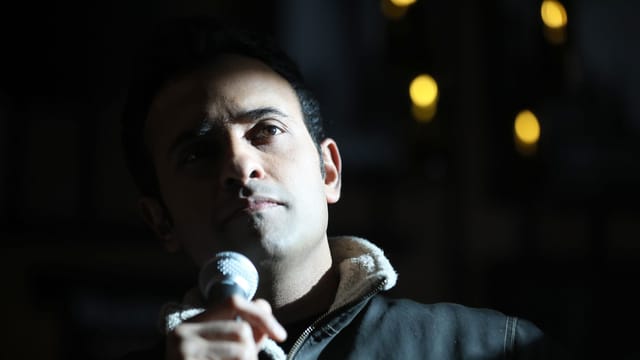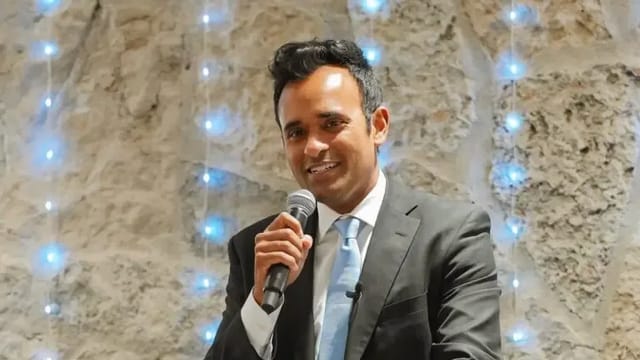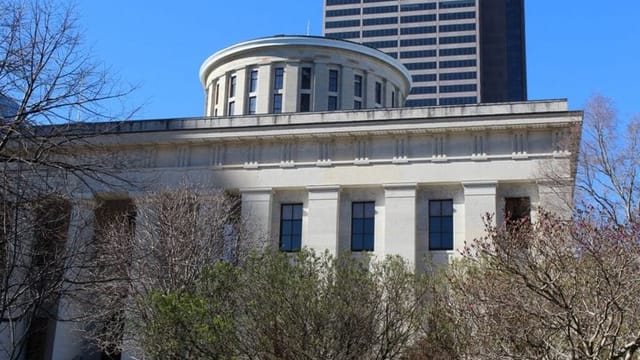

Vivek Ramaswamy is asking Ohio to hand him the governor’s office on the strength of one argument: that he sees what other people miss. The record contains a clean test of that claim. It ran for 24 weeks, enrolled 1,315 people with Alzheimer’s disease, and returned a verdict.
The drug did nothing.
By the time those patients delivered the answer, the money had already been made — by Ramaswamy, by his mother and brother on the company payroll, and by the small circle of funds that controlled roughly 90% of the stock. The people who lost were the ones who bought the story late: retail investors, and a pension fund for California’s public school teachers.
That sequence, not the failure itself, is the accountability question.
The record he bought for $5 million
GlaxoSmithKline did not quietly shelve intepirdine. It tested the compound in 13 clinical trials and dosed more than 1,250 people, including four Phase 2 studies in patients with mild-to-moderate Alzheimer’s. Then it stopped. Ramaswamy’s Roivant Sciences acquired the rights in December 2014 for $5 million upfront, plus milestones and a royalty.
Axovant’s own prospectus lays out what he was buying. Given by itself, the drug produced no statistically significant improvement in cognition or function compared with placebo. In the one trial that showed something — 684 patients already taking donepezil — GSK had set two primary endpoints. The drug hit one and missed the other: on the CDR-SB dementia-severity scale, the high dose came in at p=0.418 at week 24. Two secondary cognitive measures, MMSE and RBANS, showed nothing.
Federal regulators noticed. In an April 20, 2015 comment letter addressed to Ramaswamy by name, SEC staff instructed the company to disclose, if true, that the drug had failed to show a statistically significant improvement on MMSE or RBANS at any dose. Axovant complied.
The failures were on the table. Ramaswamy sold around them.
The family on the payroll
In 2015, Ramaswamy hired his mother, Geetha Ramaswamy, as Axovant’s vice president of medical and scientific strategy, according to an Aug. 12 investigation by Caleb Ecarma’s Oligarch Watch. The company’s prospectus confirms she was on the payroll at $250,000 a year, with a March 2015 option grant of 262,500 shares at 90 cents apiece. Ramaswamy’s brother, Shankar, was also an employee at $250,000, with an option on 750,000 shares at the same price.
Within weeks of the IPO, Oligarch Watch reported, Geetha Ramaswamy had co-published two reanalyses of GSK’s failed 684-patient trial — despite, the outlet found, having never run a clinical trial. One sorted patients into responders and non-responders instead of measuring how much they actually changed. The other, a completer analysis, dropped the more than 30% of patients who left the 48-week study. Axovant put completer-analysis data in a June 2015 filing days before the offering and used it in July to announce statistically significant benefits.
Those methods are criticized for exactly the reason they were useful here: throwing out the patients who quit breaks the balance randomization is supposed to create, and it can make a drug look better than it is. Oligarch Watch cited medical researchers who have warned as much for years. TiffinOhio.net has previously reported on that investigation and on the $260 million Forbes estimates Ramaswamy made during his time at Roivant.
The criticism was not invented after the drug failed. In July 2015, weeks after the IPO, Chardan Capital Markets analyst Gbola Amusa called the completer analysis “less robust scientifically” and less useful to regulators, said the IPO had overpriced a drug with a mixed Phase 2 history, and rated the stock a sell.
$5 million in, $315 million out
Axovant did not exist until October 2014. On June 11, 2015, it sold 21 million shares at $15 and raised $315 million at a $1.4 billion valuation — then the largest biotech IPO in U.S. history. The stock closed up about 90%, pushing the company toward $2.8 billion.
The prospectus for that offering states the company had never been profitable, had no approved products and had generated no product revenue. Its accumulated deficit was $21 million. It had not recruited a single patient for the trial that would decide everything.
Ramaswamy told Forbes the company had “a great drug candidate” that could make a huge difference for patients. On CNBC he described a drug that could help millions and said the company believed it was one Phase 3 study from approval. Roivant kept 75% of the equity. Two funds took 13%. The public float was about 10%.
Paid before the answer
Ramaswamy never held Axovant stock directly. He held Roivant, and Roivant is where the money moved.
He sold part of that stake in 2015 — the year of the IPO, two years before the trial — and reported $37 million in capital gains on returns he later released as a presidential candidate. Forbes reported he made at least $38 million in income that year. He has said he was forced to sell to make room for a new institutional investor.
Then came an extraordinary piece of timing. In August 2017, SoftBank’s Vision Fund led a $1.1 billion investment in Roivant. A Schedule 13D subsequently reported that SoftBank entities could be deemed to share dispositive power over the 75 million Axovant shares held by Roivant — 69.8% of Axovant.
Twenty days after that arrangement became effective, the Phase 3 results came in.
Oligarch Watch describes the transaction as a way for Ramaswamy to monetize the value tied up in Axovant without dumping Roivant’s enormous block onto the public market. The filings establish the timing and the ownership structure.
1,315 patients
On Sept. 26, 2017, Axovant announced that MINDSET had missed both primary endpoints. On cognition, the gap versus placebo was 0.36 points, p=0.22. On daily functioning, 0.09 points, p=0.83 — nothing. One secondary measure, a clinician impression scale, reached significance at p=0.02. The drug was well tolerated. It simply did not work.
The stock fell more than 70% in a day. Axovant shares held by the California State Teachers’ Retirement System went from about $1.23 million to $68,000, according to the fund’s SEC filings. Ramaswamy told Forbes it was the “single greatest failure” of his career and said he felt accountable to people who had bet on something he believed in.
The company tried the drug in Lewy body dementia. That failed too. On Jan. 8, 2018, Axovant killed the program. The company was later renamed Sio Gene Therapies and wound down.
Months after the collapse, Ramaswamy said he would do it again. There was probably nothing meaningful the company could have done differently, he told a 2018 conference, with the stock trading near $1.
“That is what’s most important”
There is one more exchange in the record.
In a 2023 Forbes profile, pharmaceutical scientist Raymond Schinazi recalled asking Ramaswamy years earlier about a different company, Inhibitex, whose experimental hepatitis C medicine Schinazi considered garbage. Schinazi’s recollection of the answer: “But we are making money. That is what’s most important.”
Ramaswamy denies saying it and notes that Schinazi’s own company, Pharmasset, competed with Inhibitex.
Different drug, years earlier — and the same question Axovant poses. Is the investment a success when the medicine fails?
David Niven, a University of Cincinnati political scientist, put the structure to Oligarch Watch bluntly: “heads I win and tails I also win.”
What survived
Roivant did not go down with Axovant. In 2019 it sold five subsidiaries and a 10% stake to Japan’s Sumitomo for $3 billion; Ramaswamy reported $174.5 million in capital gains for 2020. In 2023 Roivant sold its Telavant unit to Roche for $7.1 billion. Late last year, positive Phase 3 results for an autoimmune drug sent the stock up again. Forbes, which credits Roivant with helping bring multiple drug candidates to market, now puts Ramaswamy’s real-time net worth at $3 billion — and describes the 2015 IPO of a speculative Alzheimer’s drug that later failed as the thing that formed the basis of the company.
No regulator has charged Ramaswamy with anything, and he is not running on his innocence. He is running on his judgment. What the Axovant record documents is a version of capitalism in which the founder’s payout is settled before the product is tested — and he is asking to bring it to state government.
He is now campaigning to eliminate Ohio’s tax on capital gains — the same category of income through which he made much of his fortune.
Ramaswamy asks Ohio voters to judge him by his record as a businessman. Axovant belongs at the center of that judgment.
The drug failed its test.
The business model had already passed its own.